'%3E%3C/circle%3E%3C/g%3E%3C/svg%3E)
Creating data infrastructure for arts, culture and creative education
Last year, we started working with Dr. Briony Thomas and the University of Leeds, mapping the picture of creative engagement in Leeds schools. ‘Mapping Creative Arts Education: access, inclusion, and progression in Leeds’ is a collaborative research project funded by Research England, is being led by the University of Leeds working in partnership with Leeds33, Leeds City Council, and Open Innovations. This ties in with activities around the LEEDS 2023 Year of Culture, and addresses a significant lack of data available on creative education.
This evidence base will be used to inform Leeds City Council's priorities for arts and culture, the LEEDS 2023 evaluation as well as investment priorities in the region for children, families and young people.
Over the first phase of the project, the University held focus groups with schools and creative organisations, and sent a survey to every school in Leeds to understand how they engage with the arts. We used this data, and a number of other sources, to build the first open data resource on creative education.
Our work last year served as a pilot study to gauge response, validate our approach and to generate an MVP data resource. You can read more about the project in our intro blog post.
We're delighted to be working with Briony again this year. As we're about midway through the second phase of the project, here are some thoughts on our progress and plans for the project going forward:
Data infrastructure for arts and culture
As Open Innovations moves our focus toward supporting the North of England's economy, we're also building on our work with the University and LEEDS 2023 to support, celebrate and advocate for the cultural heritage of our region.
As the LEEDS 2023 Year of Culture has concluded, we've had a number of conversations with organisations who also want to ensure their own legacy and tell the story of their impact and success. Critical to this is having good networks for sharing and collaboration, and the data infrastructure in place for meaningful decision-making - this is where we help.
Through our work with the University of Leeds, Leeds City Council and others, we are starting to build the required infrastructure for schools and organisations to understand and ultimately address barriers to creative engagement in Leeds and the North of England.
It is impossible to measure the impact of a programme, or to address the social, economic and cultural barriers to engagement, without accurate, timely data and a baseline to compare against.
Efforts to evaluate the LEEDS 2023 programme highlighted that children and young people were particularly underrepresented in existing data on creative engagement, at a regional and national level.
Survey Data Publication
Our work with the University has started to fill this gap, starting by creating an online resource to visualise and publish the key findings from their research. We have supported the University with analysis and visualisation of a second iteration of the survey, seeing a better turnout in the number of responses. You can take a look at the Phase 2 Survey data here.
Schools
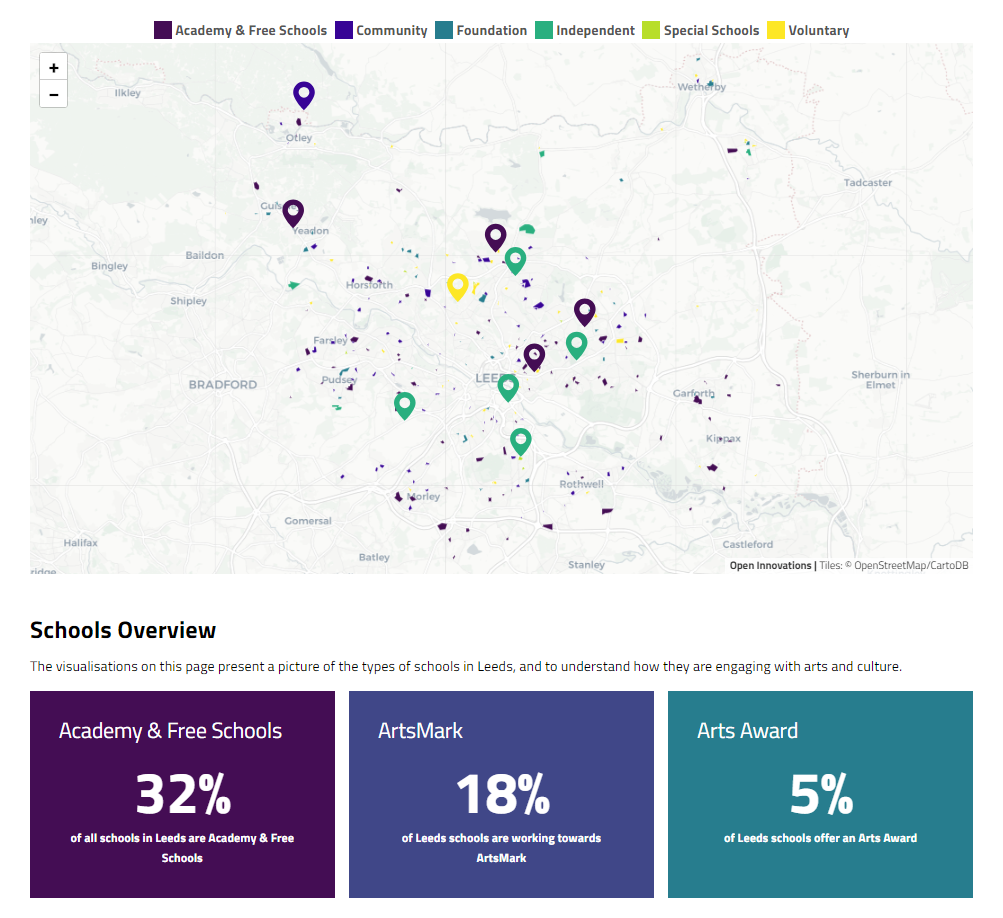
In the long term, Briony's vision is to turn results from this survey, delivered over a number of years, into a long-term view of creative engagement, collecting data at school level such as the arts curriculum, partnerships with practitioners and local arts organisations, facilities, trips, and career support available to students at each school.
We're then combining this data with other open data sources - such as schools size and demographics, creative subject entries at GCSE level and other factors such as free school meal eligibility and indices of multiple deprivation - to develop a schools-focused picture of how creative engagement varies across the region and sheds light on some of the potential challenges.
Credit: Open Innovations
Organisations
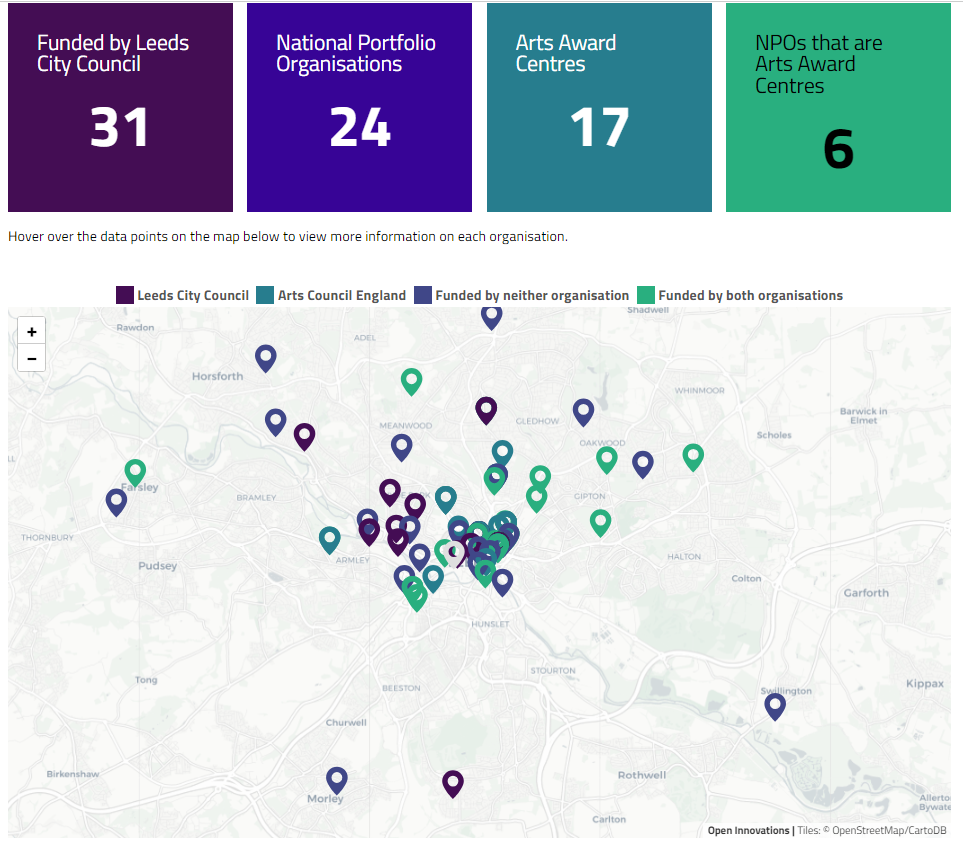
By presenting this data on the web in a way that is open, searchable and accessible, we aim to facilitate and enable schools to find practitioners and organisations to come and deliver arts enrichment activities for their pupils. We have created a tool to explore those organisations, and our goal for the future is to develop this into a comprehensive directory of creative practitioners, for schools and organisations to search, filter and find the information they need to reach out to each other and build partnerships.
Credit: Open Innovations
Data & Documentation
As always, everything we do is on the web. Recently, we have started to take a more robust approach to documenting our process and methodology when building software and working with clients. You can read more about this on our Platform site.
For this project and others, we'll be building a Data Catalogue, where visitors to the site can go straight to the data, download it, and work with it themselves. We started this approach with LEEDS 2023, and will continue going forwards to make it as easy as possible to access, use and share the data we work with. You can also view all of our code and data over on Github.
A central repository for arts and cultural data?
We've recently had a number of conversations about how to build and maintain good data infrastructure for the cultural sector. Like we see often, there are multiple actors who each collect their own data and hold on to it - not publishing for a number of reasons.
Many organisations are often asking for and working with the same data, performing the same analysis, encountering the same processing challenges, and producing the same outputs. We aim to help reduce some of this duplication where we can.
Christian Spence, our Economic Data Lead, has done this by creating an Economic Data Dashboard (affectionately named Edd), processing thousands of variables from hundreds of economic datasets into a single source.
Recent conversations have highlighted the need for a central resource for extracting and processing data relating to culture and education.
Get in touch
We'll be building on this project and collating data in the next few months, so if you find yourself performing the same repetitive analysis of education and cultural data, and would find such a resource useful - get involved.
We're also looking feedback on our Mapping Creative Education project. If you have any comments about the site, or if you'd like to get involved with the study, then definitely reach out to either myself or Briony.
Thanks again to Dr. Briony Thomas and the University of Leeds for being a pleasure to work with, and continuing to be a friend and sponsor of Open Innovations.