'%3E%3C/circle%3E%3C/g%3E%3C/svg%3E)
Wrapping up with Youth Futures Foundation
Our goal was to build an open data platform that would enable YFF and their network to understand and make decisions about the youth employment market. We wanted to help them answer questions such as: where are the data gaps for understanding economic outcomes for marginalised young people, and, from the data that is available, what can we tell about the experience of young people in the job market?
Now, after completing three phases of work, we can proudly look back on what we've delivered.
An economic data dashboard
When we first began working with YFF, the vision was to showcase YFF's own evidence into what works and why for youth employment interventions. Phase 1 saw the launch of a Data Microsite that presented findings from their own research and analysis. The microsite allowed them to share evidence on youth employment challenges and successful interventions with their network of policymakers, researchers, and practitioners.
We focused on making data accessible and usable, making sure that visualisations were easy to interpret, share, and download. The microsite became a tool for YFF to work openly, build transparency, and engage with a broader audience across government, education, and the youth sector.
Reproducible analytical pipelines
In Phase 2, we shifted our focus to efficiency. YFF's team was spending significant time manually processing open government datasets and responding to requests for data analysis. To free up more time for strategic work, we developed reproducible analytical pipelines that automated much of their data processing and visualisation work.
By creating an open and automated economic dashboard, we offered up-to-date access to essential data, replacing manual processing and reports. It became a hub to understand how the economy was impacting on young people's employment prospects.
Regional analysis
In Phase 3, we focused on regional insight, visualising economic data at a local level. We added an Areas section to the Microsite, enabling users to see data by constituency, including unemployment, economic inactivity, and where people are claiming benefits across the country. We introduced education data by local authority, highlighting regional differences in educational outcomes, as well as the NEET Factors map, which quantifies the likelihood of young people becoming NEET (not in education, employment or training) in a local authority (below).
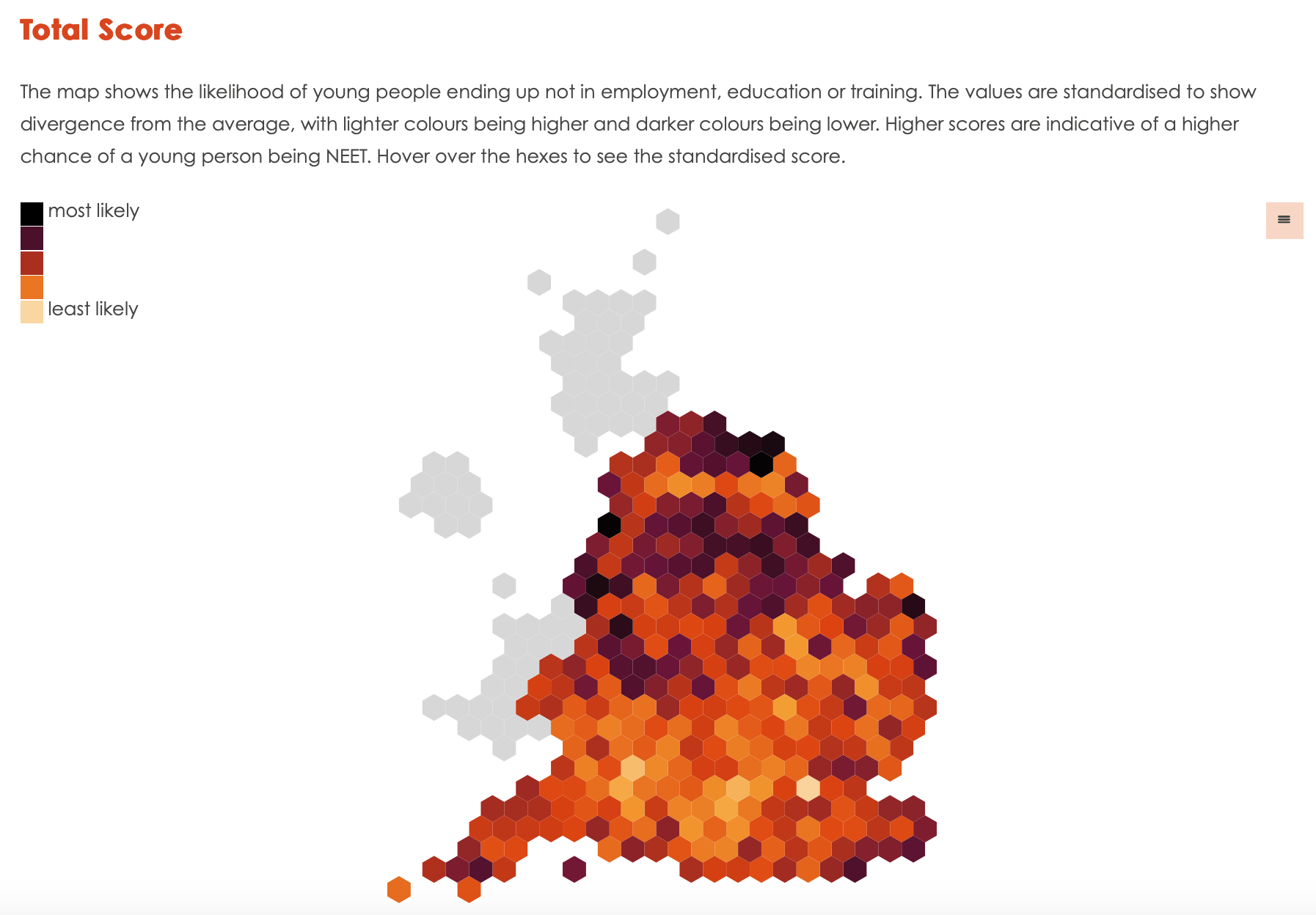
Credit: Youth Futures Foundation, Open Innovations
Open data, and reiterating the challenge of regional data gaps
Relevant, timely and good-quality data is needed to improve the experience of young people in the job market, especially those who face social and economic challenges. If this data is accessible, granular and easy to understand, we see more effective change as policymakers and practitioners can respond more quickly to real circumstances.
However, regional data gaps are still a significant challenge. Despite the progress made, and the ongoing reform of labour market statistics, there remains a lack of sufficiently granular data on local economies, particularly when it comes to specific ethnic minorities and economically disadvantaged areas. Without this data, it's difficult to fully understand the economic picture for these people and therefore to address their challenges.
YFF have done a huge amount of work to highlight these gaps and advocate for these communities to be better represented in government statistics. See more on Evidence Gaps on the microsite, where we visualised these findings.
Wrap up
As we round off this project, it's clear that the tools we've built together will continue to support YFF in achieving their mission. The Microsite provides a lasting platform for their work, ensuring that the evidence on youth employment interventions remains accessible for others to access, use and share.
We're incredibly proud of what we've achieved with YFF and for the opportunity to contribute to their efforts supporting young people. It's been a rewarding partnership, and we're excited to see the lasting impact of the methods we've advocated for: working openly and at pace.
If you're interested in this work, or would like to discuss your specific data projects, get in touch with us at hello@open-innovations.org.
Thanks to everyone who has been involved with our work this year. Have a fantastic New Year and we'll see you in 2025.
Taz