'%3E%3C/circle%3E%3C/g%3E%3C/svg%3E)
Open Data Showcase: Highlights
10 years of being radically open...
To celebrate 10 years of Open Innovations, we held an Open Data Showcase as part of Leeds Digital Festival 2023. It was a fabulous day. Lots of people showed up. Cake was eaten and there were some fantastic talks. After 10 years of ‘showing & telling’ the benefits of Open Data & Innovation to organisations, governments and individuals, it was rewarding to hear our words and advice being repeated back to us.
Paul Connell, our founder, kicked off the day. 10 years ago we were pioneering, we were one of the first not for profit organisations to:
- Build a co-working/collaborative space in Leeds
- Facilitate hackathons & unconferences
- Show & tell a credible opinion about open data & open innovation
- Use the web as it was intended
To continue to be pioneering we need to stay ahead, work at pace, spot gaps and maintain our focus. We see our challenge as ‘The relative underperformance of North England’s economy is a mystery’... Please join in with us on this next chapter.
You can view Paul's slides here.
We were then joined by some of our sponsors, partners and clients to share the work they have been doing using data, putting it on the web and sharing it widely to make a difference.
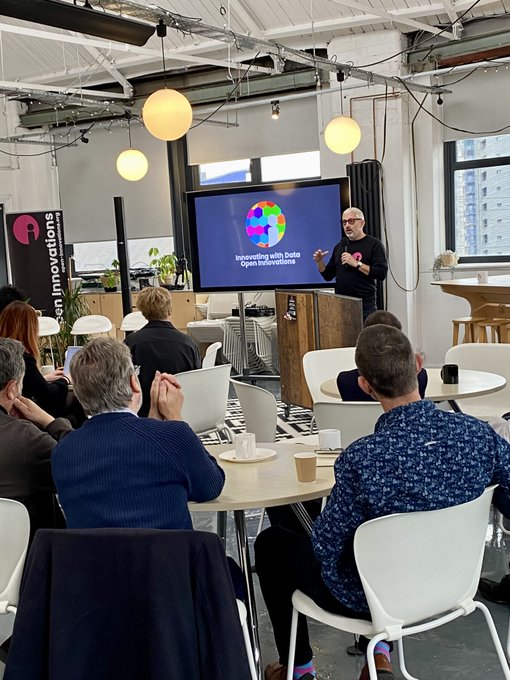
Andrew McPhillips, The Northern Powerhouse Partnership
The Northern Powerhouse Partnership aims to hold the government to account for its promises.
Andrew told us that in the past they’ve often worked with traditional consultancies who have a particular way of doing things. They write a lot of reports. They didn’t challenge their way of thinking. They wanted to move away from documents and reports towards something more interactive that models their work in a new way.
So they came to us, and we’ve been working with them to build an interactive tool to experiment and model the potential impact of current and new tax income streams. It allows local and national authorities to easily experiment with different rates of council tax, business rates, stamp duty, workplace parking levy, tourism tax and a potential local payroll tax in the spirit of that used in Paris.
This hadn’t been done before, and the reason it hadn’t been done is because it’s difficult. But we’re now most of the way there.
In Andrew’s words, the tool enables them to have better and more informed conversations. They can take people through the choices they are making and understand the potential impact of those decisions.
We’re pleased that Andrew spoke so highly of the value of our partnership. It's clear that our #RadicallyOpen approach continues to resonate with people. We’ve offered constructive challenge that is conducive to getting more done. We want everyone to spend less time on reports that are never read, and more time building tools that enable conversations.
Fiona Bolam, Leeds City Council
Leeds City Council’s priorities with open data started around the same time as their relationship with Open Innovations (then ODI Leeds).
Most recently, we’ve been supporting Leeds City Council as they update and relaunch their Inclusive Growth Strategy. The slide below sums it up. Their growth strategy needs to reflect the challenges faced at a local level.
They needed a way to easily track their progress against key economic indicators. They wanted to have all the key data they need in one place so that everyone across the council is up to date and can see the impact of their work.
Fiona told us that working with Open Innovations has given them space to think. Having access to the data has helped them see the full story of what’s going on in Leeds.
You can view Fiona's slides here.

Christian Spence, Open Innovations
Christian has an extensive background across policy, local government and academia. He has been with Open Innovations for a year now. We can’t believe how quickly this time has gone and how much Christian has helped us to achieve in that time.
Our economics work is now evolving. Christian’s work will be instrumental as we start to lay out our three year plan.
We will be putting more focus on regional economies in the North. More people are coming to us asking for help using data to advocate for their region. They want to tell their story in a way that will make people listen.
We’ll start being much more vocal about North England’s economy. How we can support it? How we can help organisations in the North to shape their story? And how can we take these stories to policy makers to affect growth and positive change?
You can explore this work for yourself via our "World of Economics" page. We’re looking for your comments, feedback, concerns, ideas and challenges.
Sarah Mace, LEEDS 2023
2023 is the unofficial Year of Culture for our city. LEEDS 2023 has been working with Open Innovations right from the start — over a year ago. They said they were looking for a ‘unicorn’. What they meant was someone to support them with the huge task of setting up a new organisation, with minimal budget. They needed a data manager role to hold everything together — a data partner - enter Open Innovations :)
We built the LEEDS 2023 Data Microsite. It brings together data from various platforms to present an in-depth picture of the organisation and its activities, impact and operations. Sarah told us that the Microsite supports their discussion and operational decision-making, knowing that the data is up to date and robust.
We were chuffed to hear Sarah tell us that LEEDS 2023 have integrated the Open Innovations way of working into their design principles across their organisation.
A few words of advice from LEEDS 2023:
- ‘Invest a chunk of time upfront'
- ‘Make it a team sport’
Data is not just for data people. Help people to use things themselves. Remove gatekeepers to information. Put things online so that you can just google it — nobody is holding you back and you do not have to ask permission.
- ‘Your sources are pipelines to the public’
The onus is on everyone in an organisation to put the right data in the right place and keep it updated. When data pipelines are automated, the source is what the public will see. Data tells a fuller picture when the sources are looked after.
- ‘Your website is your organisation, online.’

The question that LEEDS 2023 are always asking themselves is ‘does your work touch the internet?’. They think that everything you do as an organisation should be on the web and searchable.
If this sounds familiar then you have been listening to us too :) We couldn’t agree more — your website isn’t just a shop window, or a carefully curated PR front. It’s a tool and resource for external people, not just your own internal users. How often do you use your own website to look up information and access the tools you need to get things done? Reducing the time you spend beavering around trying to find information will help your organisation be more efficient.
As Sarah rightly said, ‘Culture will eat strategy for breakfast’. As we move our focus toward supporting the North of England’s economy, we’ll also be building on our work with LEEDS 2023 to support, celebrate and advocate for the cultural heritage of our region.
LEEDS 2023 are beginning to round up their activities, and they now are working closely with Leeds City Council to ‘pass the baton back’. We’ll be supporting them towards the next milestone of their organisation. This is is ensuring their legacy, telling the story of their impact and supporting other cultural organisations to deliver their own similar cultural programmes.
Evaluating the impact of LEEDS 2023 has highlighted the need for better open data on cultural engagement in Leeds. Out of our work with LEEDS 2023, we’ve also been working with the University of Leeds to address this gap in data. We’re looking forward to continuing our emerging stream of work in the cultural sector as part of our three-year plan.
You can view Sarah's slides here.
Gillian Williamson, Northern Powergrid
Northern Powergrid (NPG) has been a sponsor of Open Innovations for years. We’ve been working on its Distribution Future Energy Scenarios since 2019, and they have been publishing open data for some time now.
In 2005, the energy sector was given its first licence condition that distribution network operators must publish their Long Term Development Statements. These are datasets that provide essential information for anyone connecting to the energy network.
NPG, like us, are pioneering in their approach and ambition. Their priorities are shifting towards the better use of open data for a more efficient grid. Analysts at NPG are using models to understand and predict the demand on their network and ensure they meet net zero obligations.
NPG have their own Open Data Portal. They welcome feedback and encourage people to share how they’ve used NPG's data.
You can view Gillian's slides here.
Andrea Barry, Youth Futures Foundation
Youth Futures Foundation (YFF) is a not-for-profit organisation that aims to narrow employment gaps for marginalised young people through evidence generation and innovation. We’ve been working with Andrea and her team for over a year now. We created the Economic Data Dashboard for Youth Futures. It pulls together data from the Office of National Statistics with automated pipelines, which powers visualisations of key statistics to enable better conversations.
It is really hard to find data on employment for young people from ethnic minority groups. Error margins are wide. Figures are often suppressed due to low confidence intervals. This makes it very difficult to perform any meaningful analysis to influence policy and decision-making to benefit those people.
YFF also performs a huge amount of its own analysis to transform official statistics into evidence that is relevant for young people. The Consumer Prices Index, for example, uses the ONS ‘basket of goods’ as an index but this is not relevant for young people in the UK. It misrepresents how inflation is truly impacting the younger population.
We are now entering our third phase of work with YFF. They’ve been a delight to work with and we’re looking forward to building on our work with them in the year ahead. We’ll be looking beyond the UK borders. We aim to add international comparisons for how the UK is really holding up against other European countries — to enable conversations about what we can do about it.
We’re excited about the next phase of work. The Data Dashboard is currently a work in progress and is under active development so we welcome any and all feedback on the site.

Andrew Dyson, DLA Piper
Andrew joined us from DLA Piper, representing one of Leeds’ strongest economic sectors. He shared some of his reflections about data protection, data ethics and privacy.
He discussed how the power of open data is linked to its legislation and ethical considerations. The ability to access large volumes of data at high speeds helps people make decisions. But we must carefully consider the impacts of using and storing data on both the individual and company-wide level.
How is an individual affected if they do or don't want to share their data? And what impact does this have on the people or organisations using it?
A key takeaway from Andrew's talk was that whatever the processes are on open-data ethics, you need to bring people with you on the journey. It's too easy for people to feel left-behind and not understand how their data is used, which can be a barrier to progress. We shouldn't prevent ourselves doing important work purely because we forgot to keep people involved in the discussion. It's not just about the technical know-how!
Take a look at our work on Data Ethics for more info.
Tom Forth, Open Innovations
First, he discussed the Open Innovations did tracking buses in the West Midlands. They tracked how long buses took on their journeys compared to the timetable. They then plotted these as travel time isochrones to show the difference as a measure of the effective size of the city.
Next was the Leeds bin app. It’s an app which tells people when and which type of bin to put out for collection and can sync to your phone’s calendar. The app was built using open data and the code is openly available. Tom showed that from using open data they also produce open data about which postcodes use the app most - a proxy for digital exclusion in the city. One of the challenges, however, is the UK’s postal address file not being available under an open commercial license, which stifles innovation.
On the topic of accessibility, Open Innovations visualised concessionary travel usage across bus routes in West Yorkshire. It shows at what time of day people use each service. Unfortunately, the data for bus usage of all passengers isn’t published openly, and rightly begs the question “How can we improve the buses if we don’t know who’s using them?”.
Tom showed us his “population around a point” tool. He said that of all the work he’s done, this is the most divisive. Despite explaining the methodology and its caveats on the site directly, some have criticised the tool for its simplicity. They want cities to conform to official boundaries or their personal experiences of cities.
Tom ended with four questions he wanted to answer:
- Can we finally free the Postcode Address File?
- Can we bring franchised buses to West Yorkshire?
- Can we understand transport and accessibility in real-time?
- Can we provide the foundation for an informed and reasonable discussion about northern economic growth?
To sum up...
We mentioned our aims when we started out 10 years ago— to be #RadicallyOpen, and to put our work on the web.
Hopefully, throughout this blog you will have spotted a theme. Our speakers all shared how working with us has enabled them to stop publishing as many reports and be open on the web. We've helped them realise the value in working openly.
As a small, not-for-profit organisation, to hear our advice presented back to us, we imagine is like hearing a crowd sing your lyrics back. We couldn’t be more pleased and proud of our first 10 Years and we're looking forward to the future. Join us.